
Any time, any time while I was a slave, if one minute’s freedom had been offered to me, and I had been told I must die at the end of that minute, I would have taken it, just to stand one minute on God’s airth [sic] a free woman, I would.”—Elizabeth Freeman, aka, Mum Bett.The exact date of Elizabeth Freeman’s birth is unknown. It was the case with most blacks in the 17thcentury as they were slaves, brought to the United States from Africa as part of Transatlantic Slave Trade. No one cared when they were born or what their birth name was. They were all slaves and their skin colour was their only identity. Elizabeth was born into slavery, somewhere around the 1740s, at a farm in Claverack, New York. Her ‘master’ was Pieter Hogeboom who gave a few-months-old Elizabeth her slave-name, Bett.When Elizabeth was seven years old, Hogeboom sold her to his newly-wed daughter Hannah and his son-in-law John Ashley. It was more like a tradition for a father to pass a slave to the children at their weddings. Blacks were merely a ‘property’ to White families who considered slavery a system ordained by God. Every Black was destined for a life of hard labour.Slaves during Transatlantic Slave TradeLives of slave children was hard. Just like Elizabeth, most of the children were separated from their parents at an early age and were forced to work 15 to 20 hours a day. Those who toiled in huge cotton fields in the deep-south suffered much more than those who worked in the house. Elizabeth, in that sense, was fortunate to work as a servant and not a labourer, but her life was far from easy.Raised in a stern Dutch family, Hannah had a short temper and was insensitive to the slaves. At her residence in Sheffield, Massachusetts, Elizabeth did all kinds of chores, from cleaning and washing to cooking and nursing children. There was no room for error; there was no mercy when a slave made a mistake. No rest and no days off either. Each day was a battle to make it to the next. But despite the tyranny and inhumane treatment, Elizabeth was undaunted in her spirit.in - This website is for sale! - spirit Resources and Information. 1780, when Elizabeth was around 36, she saved a young girl named, Lizzy, from Hannah’s wrath. Some accounts say Lizzy was her sister, others say she was her daughter. Irrespective of her personal relationship with Lizzy, Elizabeth was the kind who would stand up for anyone from her slave community, even if it meant going against Hannah.One day Hannah found that Lizzy had baked a cake for herself from the scraps of a “great oaken bowl in which the family batch had been kneaded”. To her, it was blasphemy. Boiling with rage, Hannah swung a heated shovel at Lizzy, but Elizabeth came in between to take the blow. It was the first time that Elizabeth defied her mistress, and it wasn’t the last.The never-ending nightmare of slavesSoon after the incident, Elizabeth left Hannah’s residence, never to return. She was perhaps the first Black in Massachusetts to do so, as every slave feared the law and retribution. But Elizabeth knew what other slaves might not have known at that time. The law had changed. While running errands one day, she had heard people discussing the newly ratified constitution of Massachusetts that read: “All men are born free and equal and have certain natural, essential, and unalienable rights; among which may be reckoned the right of enjoying and defending their lives and liberties; that of acquiring, possessing, and protecting property; in fine, that of seeking and obtaining their safety and happiness.”Armed with this knowledge and hope of freedom from slavery, Elizabeth sought the council of Theodore Sedgwick, a Yale University law graduate, who was one of the city’s most reputed lawyers and a supporter of abolition. He was faced with the biggest test of his career and life as such a case was unprecedented. On the one hand, he had to fight against his friend, the Ashleys, but on the other, he knew she was right about the law. His moral compasspointed towards Elizabeth and he agreed to defend her case.Sedgwick first filed a writ ordering the Ashleys to release Elizabeth and another male slave Brom as they weren’t their ‘legitimate property’. When the Ashleys refused, Sedgwick filed an action in the County Court of Common Pleas in Great Barrington. Brom and Bett versus Ashley was tried before the jury, where Sedgwick argued that slavery was against the constitution of Massachusetts. The jury ruled in favour of Elizabeth and Brom, and the court granted them their freedom from slavery. Her case became an inspiration for other slaves who decided to follow in the footsteps of Elizabeth and sue their masters for inhumanity and equal rights. It was a kind of revolution that Massachusetts had never seen before. Eventually, the court abolished state-wide slavery from Massachusetts setting every slave free—so long considered a vague and distant dream.After gaining her freedom, Elizabeth got a job at Sedgwick’s house as a housekeeper and governess to look after his children. One of them was Catharine Sedgwick who wrote about Elizabeth in her books. Catharine grew up listening to stories from Elizabeth about her life—the author admired her grit and courage, but above all, she idolised her view towards humanity and equality.In 1829, Elizabeth died a free woman. She was buried in the Sedgwick family cemetery known as “Sedgwick Pie”. Her epitaph reads: “She was born a slave and remained a slave for nearly thirty years. She could neither read nor write, yet in her own sphere she had no superior or equal.”
Author: grassrootlevel
I am passionate blogger who write articles on happiness, peace, well-being, spirituality, health, diabetes and Ayurveda treatment cum medicine.
ALTERNATIVE WAYS TO HEAL YOUR PETS
When we’re distressed, we know we can ask for help. We talk, we describe our issues and seek out doctors, therapists, and healers. But our furry friends are not so lucky. More often than not, they suffer in silence. Rarely do they even shed tears. It’s not until we realise that our darling four-legged creatures might be in pain or distress that they get help.
The veterinarian is, of course, our foremost option. Sometimes, taking our pets to the vet might not be enough. Just as we seek out therapists and healers, our pets too might need a specialised, alternative therapist. There’s a wide range of healing modalities that can be adapted to heal animals–acupuncture, pranic healing, myotherapy, crystal healing, reiki, homeopathy, and many more.
Except for myotherapy, which works on the physical body, the other modalities work on the aura (energy body) of the subject, to help relieve them of their problems. Just as humans have auras, so do animals. In his book Aura Energy for Health, Healing & Balance, parapsychologist Dr Joe H Slate writes: “The auras of animals are typically less complex in structure but more intense in coloration than human auras.” The intense colouration Dr Slate refers to is probably correlated to the density of the energy body; many energy healers observe that animal auras are denser than human auras. However, the healing works on similar principles anyway, be it for people or pets.
When applied on animals, these healing modalities are known to help with physical and psychological ailments. While they might not be replacements for allopathic medicine or behavioural training, they are certainly strong complementary therapies, and can be very helpful in pain management, stress reduction, and better quality of life. Soulveda speaks to experts on how these therapies can help animals.
Myotherapy is muscle therapy for dogs, wherein they are closely evaluated with respect to how they move–walking, sitting, getting up.
Acupuncture can stimulate a subject’s brain and spinal cord to release pain relief hormones called endogenous endorphins.
FINDING FRIENDS LATE IN LIFE
If life is a journey, friends are the fellow travellers that make our journey unforgettable. The moments we share with our friends always remain vivid in our memory—be it playing games in the elementary school, gossiping about our crushes as teens, or going to a friend’s wedding as the best man or the maid of honour.
But once we’re past our formative years, we might find that we no longer make friends as easily. What was once part and parcel of life might suddenly require conscious effort. According to a study published in the Psychological Bulletin, an individual’s circle of friends starts shrinking by the time they reach their late 20s .
It is not all that surprising. As children, we were willing to be vulnerable. But as adults, we tend to conceal our vulnerabilities from others. As children, we weren’t judgemental. But as adults, we are set in our ways that limit our pool of friends. Add family commitments, jobs and our own mental blocks to the mix and there is hardly any space to squeeze in new friends.
But on the bright side, we mature with age and we learn how to build and maintain friendships with people who are right for us. This Friendship Day, Soulveda speaks to people about the challenges they face in making new friends later in life, and what they do to overcome them.
5 SYMBOLS FROM WWII AND WHAT THEY STAND FOR
Most of us have experienced World War II (WWII) only through the pages of history and cinematic renditions. Whether it is the Invasion of Normandy scene from Saving Private Ryan or the helplessness of Jews as rendered in The Diary of Anne Frank, the horrors of WWII (1939-1945) are etched in our memory. In those dreadful six years, the world witnessed every emotion one can go through—fear, anger, sorrow, hope, and eventually, happiness.
The war wasn’t just about absolute power, it was also about discerning human limitations and a test of man’s willpower. In this feature, Soulveda is turning the wheel of time to relook at the period through some of the popular symbols, each representing a stage of WWII and triumph of the human spirit.
Swastika, the symbol of fear
Swastika, a Sanskrit word that means “good fortune”, has a history that dates back to 5000 years. To this day, the motif is seen as a symbol of divinity by Hindus, Buddhists and Jains. During the mid-nineteenth century, the symbol rose to popularity when a German archaeologist Heinrich Schliemann discovered the hooked cross on the site of ancient Troy. From that time onwards, the symbol was linked to the Aryan race that was seen as ‘superior’ to others.

In the 1930s, during the rise of Nazi power, Hitler adopted swastika as the emblem of his party. In Mein Kampf, Adolf Hitler wrote: “I myself, meanwhile, after innumerable attempts, had laid down a final form; a flag with a red background, a white disk, and a black swastika in the middle.” When Hitler became the dictator of Germany, he emblazoned every street, building, products with swastika. His plan was to colour whole Europe in red with the symbol of fear. As he expanded his territory outside Germany, innocent people were thrown out of their house; many were sent to concentration camps; others were killed mercilessly. Even those who were far from Hitler’s reach feared the same fate. They knew he was coming, with his treacherous army and swastika.
Yellow Star, the symbol of horror
WWII was a nightmare for the innocent people who wanted nothing but peace and harmony in their lives. But if there is one race that suffered the most during the war, it was the Jews. With the number of civilian casualties running in to millions, the European population of Jews was reduced to fringes by the Third Reich. It started with the decree that they must wear a yellow star—a six-sided star, in an armband, with the word Jew inscribed on it.

This was their systematic plan to persecute and destroy the Jewish population of Europe. According to the law, all Jews over the age of 10 were forced to wear that star on the armband. Poland, Croatia, Austria, Belgium, Netherlands, Romania—in all the countries where the Nazi flag flew, the law was imposed on the Jews. After their segregation, the Jews were transferred to ghettos and from there to the death camps, where they continued to wear the star till their last breath.
Red circle, the symbol of death
By late 1944, the tide of war was against the Empire of Japan. Their enemy, the United States had become an industrial superpower; a force they were not equipped to deal with. In desperation, Japanese military leaders created a suicide unit called Kamikaze, comprising young soldiers who were instructed to nose-dive their planes into the warships.
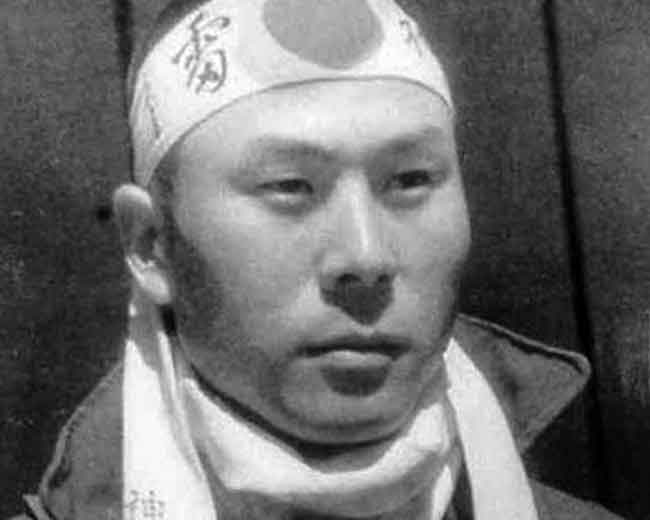
Teenagers and young adults who were still under training were ‘asked’ to volunteer for the Kamikaze unit. With jets full of explosives, the Kamikaze pilots attacked the American fleet in October 1944. The pilots were expected not only to embrace death for the sake of the emperor but also to cause large scale destruction at the enemy’s end. Kamikaze pilots had a tradition to wear a white headband with a red circle inscribed it. This band became the symbol of death in the Pacific.
V, the symbol of victory
Winston Churchill, the British Prime Minister (1940–45, 1951–55) ushered England to victory in WWII, when his country stood alone to face the Third Reich that had crippled Europe. It was the darkest hour for civilians and brave soldiers alike, who feared for their freedom and safety. Germany initiated “Operation Sealion”, a cross-channel invasion of south-east England during mid-1940. In August, German air-force Luftwaffe launched an attack to establish air superiority over England. A local newspaper vendor in London is reported to have said: “Well, we’re in the final, and it’s on the home ground.”
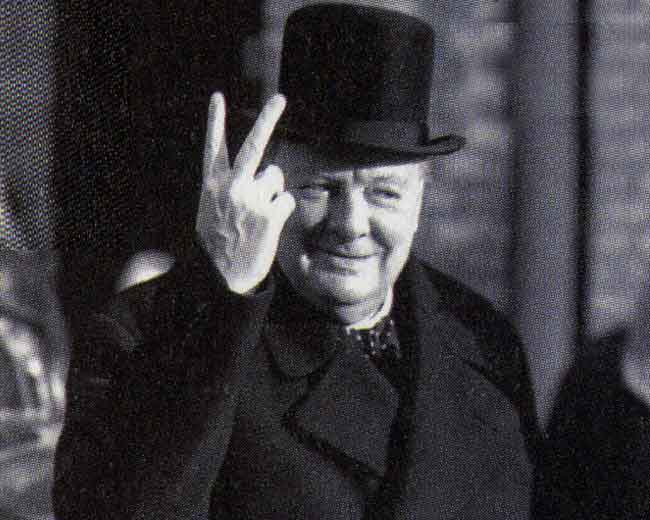
Germany underestimated their enemy, especially their resolution to fight back. Luftwaffe suffered heavy losses in the battle that eventually compelled Hitler to postpone Operation Sealion indefinitely. Churchill saw this victory as an opportunity to bolster the spirit of his fellow citizens. His hand gesture of V—which meant victory—became the source of inspiration for everyone. Not just England, but people from around the European continent were now looking up to Churchill to liberate Europe from Hitler. His V gesture was his promise to everyone that he will fight in the fields, in the streets, in hills, and that he will not surrender—as he famously said in the House of Commons while referring to the Dunkirk evacuation.
Origami Crane, a symbol of hope
Whether it was the allied or the axis power, it was the innocent citizens of every country who paid the price of the war. People prayed to every God they believed in for the end of this gruesome period. Sadako Sasaki was one such girl who prayed for her life after she was diagnosed with leukaemia, a terminal illness she got from the Hiroshima atomic explosion. Sadako was two years old when the US dropped the atomic bomb in Hiroshima. As a result, countless children like Sadako contracted the illness after being exposed to heavy radiation.

Doctors had lost all hope but the young girl wasn’t ready to die. She believed in the Japanese legend that anyone who folds a 1000 origami cranes, gets a wish granted. So, she began making those origami cranes in the hope of being granted her wish to live. Sadako had made 644 cranes before she breathed her last. Her story became the source of hope and peace across the nation, something Japan needed desperately after the war. In 1958, a statue of Sadako holding a golden crane was unveiled at the Hiroshima Peace Memorial Park. Her plaque reads: “This is our cry. This is our prayer. Peace on Earth.”
LITTLE KIDS WITH BIG HEARTS
It was a sunny, summer afternoon when a little boy and his sister went inside a rather busy ice cream parlour. They had just finished with their exams, so what better way to celebrate the onset of summer vacations than by treating oneself to ice cream? The duo sat at a vacant table and went through the menu. After deliberating on what to order (for a long time), the siblings finally came to a consensus.
“How much is this ice cream sundae?” the boy asked, his big blue eyes wide, as the waitress approached him.
“60 rupees,” replied the waitress, nonchalantly.
The little boy then took out a few coins from his pocket and started counting them. After a brief pause, he whispered something into his sister’s ears.
Moments later, “How much is this cone of ice cream then?” the little girl inquired meekly.
“15 rupees,” she answered.
When the little boy started counting the coins again, the waitress got impatient. “Come on, make it quick, kids. Can I take your order or not?” she asked, sounding rather curt. It was a busy day at the ice cream parlour that day and she did not have the time nor the patience to deal with little children and their dillydallying.
“Yes. We’ll have two cones of chocolate ice cream,” the boy confirmed, after taking his own time with the counting.
The waitress brought the kids their chocolate ice cream cones, put the bill on their table, and walked away brusquely. The children relished their ice cream, paid the cashier 30 rupees and left for home happily.
When the waitress came back to clean the table the children were sitting at, she was in for a surprise. For, placed neatly beside the empty ice cream cups was a little note that read ‘we’re sorry’ with a sad smiley. The waitress felt guilty about having been impatient with the two children. She was moved by the little kids’ big hearts.
LOVE KNOWS NO SHACKLES
Why can’t I just tell her? This cannot go on forever… Rick’s conscience was nagging away at him for several months now. He finally convinced himself to tell Elsa the truth. Yet he couldn’t bring himself to say it. Lying in bed beside her, tossing and turning, he watched his girlfriend of two years sleep, her face innocent with a childlike smile. Rick feared that the truth might shatter not just their relationship, but also her fragile heart. God, help me do the right thing… Rick sighed.
As he reminisced about that warm summer evening ten months ago, Rick’s heart sank a little. He had been sitting alone at that bar after work, waiting for his co-workers to join him. He could never forget that moment when he first saw Kenny across the room. Their eyes met and the chemistry between them was too obvious to ignore – for either of them. It was an overwhelming urge to get to know each other. Promptly, numbers were exchanged, texts and calls going back and forth every day. The two of them connected as if they’d known each other forever. Even as Rick realised he was fascinated by Kenny, he remained faithful to Elsa. In fact, he had made sure to tell Kenny about Elsa, and discouraged any expectations from Kenny’s side. Kenny being a gentleman respected Rick’s decision. Over the course of time, however, being just friends wasn’t easy. Rick realised that sooner or later he would have to make a choice—a choice that would shake and disrupt everything his life had been until then.
5 MYSTERIOUS PLACES THAT CAPTURE THE IMAGINATION
Man is curious by nature. His insatiable thirst to seek answers has led him to the unchartered waters and unknown territories of the mysterious world. His quest brought him closer to the inexplicable quirks of nature. Along the way, he found answers to a few insoluble questions, while many remained unresolved as ever. But the curiosity he started his journey with only grew as he evolved and philosophised.
As he went along, he discovered nature’s various creations, waiting for him to unravel its mysteries. Soulveda set out to explore this fascination human being display for mystery and adventure. Here are five mysterious places in the world that are intriguing, riveting and enchanting at the same time—the explanations science may have offered for these mystery elements notwithstanding.
Bermuda Triangle
Who hasn’t heard of the infamous Bermuda Triangle in the North Atlantic Ocean off North America? This mysterious stretch of the Atlantic Ocean or ‘the Devil’s Triangle’ is associated with the strange disappearance of many ships and aircraft. Author Gian J Quasar in his book, Into the Bermuda Triangle: Pursuing the Truth Behind the World’s Greatest Mystery, stated, “There is a growing belief that there is something very different out in the Triangle as opposed to other seas. Since ships and planes disappear in like manner, there seems to be little possibility that ordinary mishaps such as pilot error, vertigo, fuel exhaustion, getting lost, disorientation, or natural disasters like tidal waves, cyclones, or whirlpools can be the sole culprit. While some of the above can be deadly to planes, they are not to ships and vice versa.”
His statement is believed to be true, though nothing has been proved scientifically. Experts have relied on supernatural theories, violent weather, and anomalies in compass variations to justify the mysterious tales of sunken ships and drowned planes. But, they are just attempts at scientific explanations. It remains the biggest mystery, till date.
Eternal Flame Falls
The Eternal Flame Falls in western New York is a real mystery to behold. The flame emanates from a crack beneath the Shale Creek and flickers continuously despite the flow of water. The mystery is the fire never goes out and it’s a complete natural phenomenon.Several pieces of research reveal that the rocks underneath the park aren’t hot enough to produce gas nor does there seem to be any other method of producing gas. So, what is making the fire burn eternally? Scientists are still baffled and unsure of what actually keeps the flame alight.
Yangsi village
Yangsi village in China’s Sichuan province is quite well-known, as nearly half of its residents are dwarfs—the tallest villager being 3 feet 10 inches, and the shortest only 2 feet 1 inch. One set of locals believe that the dwarfism is the result of the wrath of their ancestors who were not given a proper burial. Although, the absurdity caught the scientists’ attention, they couldn’t actually get to the bottom of this strange phenomenon.The legend goes that a man named Wang once spotted a black turtle that had strange feet. Villagers were delighted to see something so bizarre but they wanted to let the turtle go. However, some villagers killed the animal and ate it. Since then, the curse of the dead turtle is believed to be the cause behind the unusual dwarfism in the village.
Overtoun Bridge
This bridge in Glasgow, built in 1895, will make the hair stand up. A harmless piece of architecture for decades, in the 1950s it began to be referred to as the Bridge of Death. Know why? There were reports of dogs ‘committing suicide’ by plunging to the rocks below the bridge. There have been incidents where as many as fifty dogs leaped to their deaths from the bridge—from the same side and the same spot.These dogs are believed to have been of the same breed of long-nosed hunters, typically with a strong sense of smell. According to some experts, dogs crossing the bridge are drawn in by an ‘optical illusion’ whilst others theorise about ghosts. Although these are some assumptions, experts have not found the exact reason behind the leaping of these dogs off the bridge.
Devil’s Sea
Devil’s Sea, a part of the Pacific Ocean, south of Japan, is often referred to as the Pacific Bermuda Triangle for its association with paranormal phenomena, mythical legends and other unresolved time warp theories. In the mid-1950s, nine freight ships and several fishing boats were reported missing from the region. A crew of 31 sailors was sent by Japan to investigate the disappearance of the vessels, but the ship met with the same fate while crossing the Devil’s Sea. Following this incident, the Japanese government declared the region as dangerous for any expedition or rescue operations.It wasn’t the first time sea vessels had vanished into the thin air near the Japanese coast. In fact, the legend of Devil’s Sea goes way back to 1200s CE, when Kublai Khan, the fifth Great Khan of the Mongol Empire and the grandson of Genghis Khan, lost around 40,000 soldiers to the mysterious currents of the Pacific Bermuda Triangle. Such inexplicable incidents gave Devil’s Sea its infamous name Dragon’s Triangle, which means abode of marine dragons.
OCD IS NOT AN EVERYDAY DISORDER
Have you wondered why your colleague obsessively scrubs her hand till it’s almost bruised or why your boss always insists on keeping his eclectic collection of pens arranged in a particular order? That’s perhaps because they both suffer from a kind of anxiety disorder that they are either unaware of or choose not to speak about.
Obsessive Compulsive Disorder or OCD is a chronic, anxiety disorder that is much misunderstood and, therefore, loosely used by people. Commonly, it’s connected with personal hygiene and perfectionism. In reality, OCD is much more than washing hands or organising pens in a certain order. It is about the anxiety victims face while curbing intrusive thoughts such as the presence of germs everywhere, or dealing with disarray in everyday life. That is why the roots of OCD go way deeper into the subconscious mind of a person and distort their perception. “What sets apart those who are suffering from an anxiety disorder, of which OCD is one, is another idea, unspoken, but powerful, that lies underneath the surface. It is the idea that danger is lurking everywhere,” writes Dr Fredric Neuman, Director of the Anxiety and Phobia Treatment Centre, on his blog.
The unspoken idea that New York-based psychiatrist Dr Neuman talks about, is rather elusive in nature. Only people suffering from OCD realise they are going through it. Those witnessing it, perceive it as a personality quirk rather than a disorder. Owing to the low awareness around the disorder, people associate OCD with various commonplace activities, such as cleaning the house till it is spotless. Albert Rothenberg, professor of Psychology at Harvard University explains the difference between “liking” a clean house and obsessive cleanliness. “In the latter, you will have the presence of rigidity, excessive attention to detail, preoccupation with control of disorder and dirt. The latter can be measured by amounts of time spent on cleaning, intolerance of the slightest disarray or disorder, and punitive response to change or interference by others,” says Rothenberg.
Another major misconception around OCD is that it can be tamed by a person suffering from it, if he chooses to. How hard is it to control an irrational behaviour? Dr Ashlesha Bagadia, a clinical psychiatrist, dispels the notion that it can be tamed: “There is repetitive behaviour to reduce the anxiety caused by the obsessive thoughts, but the repetitive compulsions don’t reduce the anxiety much, and they can get caught up in a vicious cycle of obsessive thoughts and compulsive behaviour.” Once anxiety kicks in, it springs compulsive behaviour that fuels the anxiety even further—it becomes a process that runs on itself, making OCD difficult to control.
Take the case of Aditi, a young mother, who had been struggling with OCD for more than five years. Aditi had compulsive cleaning behaviour and contamination phobia. She couldn’t use a washroom if someone had used it before her. She would spend hours cleaning the bathroom or bedroom, even if someone touched an object. Aditi even had to quit her job because of her obsessive compulsions. Her husband supported her, but in his own ways. For the most part of it, he believed her condition was incurable, and only she could control her OCD through a strong will and determination. However, not everyone can rise above OCD just through willpower. Dr Bagadia explains, “For people with OCD, they never know when the anxiety will grip them and when they will lose control. They are unhappy about their own condition but feel compelled to act that way anyway. That’s why they are called compulsions.” Aditi’s condition took a turn for the worse when she had her first child.OCD tends to worsen during pregnancy and the postpartum period because it’s the most unpredictable time for a woman, and people suffering from OCD struggle with unpredictability. “Being anxious during pregnancy can cause a lot of harm to the developing infant. During the postnatal stage, the infant can be fussy, and not easily soothed by a mother who’s anxious herself,” adds Dr Bagadia. Aditi eventually realised that if she didn’t get professional help, it would affect her relationship with the child. With her husband’s support, she sought help. They both spent time in understanding the condition and the best option for treatment—a combination of medication and therapy. After months of therapy and support from her husband, Aditi was free from her illness. Now, she spends her days enjoying being a mother, and is looking forward to getting back to work, as well.
Family and friends play an important role in one’s battle against OCD. Without them or any other emotional support, an individual with OCD may find it quite difficult to escape its perils. Consider 45-year-old Ashok, who lived alone in an apartment. He lost his mother when he was young and had no siblings. When his father, too, passed away, his OCD worsened. Ashok had obsessions around symmetry and numbers, which were followed by checking behaviour that would go on for hours every day. To suppress his anxiety, he would arrange his desk in a particular order every morning, spend hours going through reports, miss deadlines and often argue with his co-workers if something was not done the way he preferred them done. Due to his compulsive behaviour, Ashok sunk into depression. That’s when his boss came to the rescue.
He connected Ashok to a therapist who suggested behaviour therapy to reduce his compulsive behaviour. The therapist helped Ashok look beyond his trauma of losing his parents, which was a trigger for his OCD. Through daily practice, Ashok was able to overcome his disorder and return to a normal work life.
When others start recognising OCD as a disorder, and not some “every-day-behaviour”, it becomes easy for patients to cope with their anxiety. It is an assurance that they are not alone in their battle. “Many people don’t open up for the fear of being teased or laughed at, especially for something that looks trivial to the observer but can be really painful to the sufferer,” says Dr Bagadia. The first step for any family member or a friend is to build trust. Once a person suffering from OCD feels comfortable sharing his predicament, people can suggest corrective measures to deal with it. “Family members should strongly encourage possible long term psychotherapy and ensure the patients take their medication, refuse to comply with obsessive and compulsive demands for absolute cleanliness and rigidities of behaviour, etc. The most important is to support and maintain optimism about continuing treatment,” adds Rothenberg. The assurance of not being alone is bigger than any intrusive thought or compulsive idea. If those with OCD have the unflinching support of their loved ones, they can win their battle quite comfortably.
5 RIVERS THAT FLOW AGAIN
Agushing river with its steady flow of fresh water is a thing of beauty. Simply watching it flow can be a calming experience. Rivers don’t just add to the picturesqueness of a landscape, but with an entire ecosystem within them, they also sustain various lifeforms, including humans. Fertilising the land they flow across, they facilitate agriculture. Providing us a means of transportation, they encourage trade. In fact, in the 21st century, rivers are also a source of energy that help generate electricity. Clearly, rivers are a prerequisite to sustenance of mankind and civilisations. No wonder, since ancient times, several civilisations developed in and around river beds, such as the Nile and the Indus.
Despite the fact that rivers sustain us, we take these water bodies for granted, as we do with other natural resources. So, we seldom feel guilty while polluting them or disrupting their flow by constructing dams. But, teeming with aquatic flora and fauna, rivers, in that sense, are very much alive. And they do suffer because of human neglect. In fact, rivers die a gruesome death when they are unable to sustain life forms such as fish and aquatic plants in them. Oxygen levels in their waters get depleted, acidity of their waters increases, thereby killing their flora and fauna.
A river can die for a variety of reasons, but like a phoenix, they can come alive once again. Even when a river is extremely polluted or has dried up, they can be brought back to life. In this article, Soulvedalists a few rivers that were revived through restoration projects.
Cheonggyecheon River, South Korea
Cheonggyecheon river is a creek that now flows west to east through downtown Seoul, South Korea’s capital city. It meets the Han River before emptying into the Yellow Sea. However, during the late 1950s, the then polluted river was covered up by concrete. In fact, a highway was built in the river’s path, burying the dead river for good.
Decades later, in 2003, the then mayor of Seoul, Lee Myung-bak proposed Cheonggyecheon be restored. This project aimed to integrate the well-developed concrete jungle of Seoul with nature. And so, the highway was once again demolished. In its place, an artificial stream was constructed, dotted with linear parks. Around 120,000 tonnes of water were pumped into this stream from the Han River and its tributaries to revive it. And today, despite being an ‘artificial’ river, Cheonggyecheon provides visitors and residents with ecological benefits. It cools the areas near the river, and even provides habitat for fishes, birds and insects.
Varattar River, India
Varattar, a tributary of the Pamba river, used to be an important river of southern Kerala. In its glory days, this river sustained hundreds of households. But, illegal sand mining and land encroachment killed Varattar some decades ago. The dead river was further encroached upon by short-sighted real-estate developments.In a campaign called ‘Varatte aar’ which means ‘let the river flow’ in Malayalam, the people of Kerala decided to revive the Varattar river. Pooling together resources and manpower, several unlawful man-made structures that were built along the river’s path were cleared. Illegal sand mining was also banned. Interestingly, once the path of the river was cleared, and with the onset of the monsoon rains, the river started flowing through its forgotten path once again.
Penobscot River, USA
The river ecosystem is a fragile one. It thrives on a delicate balance between its flora and fauna. So, anything which affects this balance could potentially affect the river for the worse. For instance, since ancient times, the Penobscot river has always been home to a fish breed called the Atlantic salmon. But with the construction of the Milford dam, West Enfield dam and Weldom dam, the salmons lost their habitat for spawning. Furthermore, when the riverbed was affected by timber harvesting activities, protective pools for spawning of these fishes were destroyed. So, not only did the health of Penobscot river deteriorate (their water flow was disrupted by dams), salmons too got enlisted on the endangered species.The Penobscot Project was hence aimed to restore the population of Atlantic salmons without affecting the hydroelectric power generation. As one of the most innovative river restoration projects, up to 2,000 miles of the river was opened. Two dams that blocked fish migration were demolished and an innovative river-like bypass was constructed around the third dam. The fish now use this bypass to access their historic habitat. As a result, the population of critically endangered Atlantic salmon, as well as other fishes such as the river herring, shad, American eel have gone up.
Arvari River, India
Many a time, we tend to think that a river restoration project is a huge undertaking. But environmentalist Dr Rajendra Singh, dubbed the waterman of India, proves us wrong. Single-handedly, he has revived several rivers in Rajasthan. For instance, to revive Arvari river that had remained dry for over 60 years, Dr Singh, with the help of villagers, built 375 johads (a rainwater storage tank principally used in the state of Harayana and Rajasthan) along the riverbed. Decades later, all his hard work paid off when Arvari started flowing. Today, this 45-kilometre-long perennial river flows through the Alwar district of Rajasthan.Encouraged by his success, Dr Singh now runs an NGO which has been instrumental in fighting slow bureaucracy and illegal sand mining on riverbeds. Over the years, he and his team have built over 8600 johads and revived five rivers within Rajasthan.
River Thames, UK
In the late 1950s, River Thames was declared biologically dead. During the wartime, several Victorian sewers that kept the river clean were demolished, and River Thames became a foul-smelling drain. Post the war, for almost a decade, Britain did not have the time or the resource to clean it up. It was only in the late 1960s that their sewer system improved.
Over the next few decades, environmental awareness increased which led to strict regulations on pesticides and fertilisers that washed into the river. The once deemed dead river began to breathe again. Today, River Thames is one of the cleanest rivers to flow amidst a well-developed city. Even the fishes are back. In fact, the river is now home to over 125 species of fishes from almost none in the 1950s.
BE FREE, BE RESPONSIBLE
As a child, I didn’t have much in the way of personal freedom. My parents had imposed strict rules about study and play time, and I wasn’t allowed to go out a lot. The atmosphere at home was quite restrictive and I hated it; I couldn’t wait to move out and go off to college. Little did I know that all the freedom I desperately wanted came with a lot of responsibilities.
Even though college life wasn’t devoid of rules, I enjoyed freedom of many kinds. I could stay up all night, eat junk food and watch movies whenever I wanted. There was no fixed study time; there weren’t too many assignments to begin with. And I was free to fill my wardrobe with clothes of my choice. While it was all refreshing at first, the novelty wore off soon. I found myself dozing off in classes because I hadn’t gotten enough sleep. I flunked a few tests because I hadn’t bothered preparing. And all the fancy clothes I bought drained my pocket money, leaving me broke.
My parents had indeed warned me that freedom came with responsibility. But I didn’t understand what that meant until I faced the consequences of my irresponsible behaviour. And this lesson is one I continue to remind myself to this day, for it is easy to take freedom for granted. Each of us might enjoy freedom of many kinds—freedom of belief, choice and expression; freedom to live life as we want. But when exercised carelessly, it might hurt us and those around us. For example, everybody is free to go out for a couple of drinks after a long day at work. But when someone irresponsibly decides to drive home after drinking, they stand to hurt themselves and those on the road.
As it turns out, we all have the freedom of choice, but we are not free from the consequences of our choices. Of course, our hope is that the consequences are ‘good’ and beneficial to our lives, but there is always the chance that things could go wrong. Lekha B, a finance professional, recalls an incident from her life when freedom cost her, quite literally. “A few years ago, I got a credit card to help me manage my expenses better. It was exciting, as I felt like I had the freedom to spend money on things I liked at any time during the month. But eventually, when the bill came due, it was always a shock. I couldn’t believe how much I had spent. With the mistakes I made came the lesson that I can’t pull out my credit card every time I felt the urge to buy something,” she shares.
Lekha isn’t alone in her experience. Many among us might have gone through something similar before learning our lesson. Maybe, in a sense, we are all wired to take our freedom for granted. When we have something in abundance, we assume it is something we would always have. We might even be tempted to abuse it once in a while. Psychologist Joy Bannerjee agrees. “It’s in our nature to take our freedom for granted and not value it. We forget the cost and condition we have to exchange for that freedom,” he says.
The solution, then, is to be mindful of what freedom means to us and how we exercise it. This would help us practise active restraint and judgement while taking decisions. While this might be easier said than done, it is something we must work on, given that the alternative would mean squandering our freedom and opportunities. As American activist Eleanor Roosevelt once said: “Freedom makes a huge requirement of every human being. With freedom comes responsibility. For the person who is unwilling to grow up, the person who does not want to carry his own weight, this is a frightening prospect.”
Inputs provided by Sai Priankaa B
 Grass Root Level